

Bubbles bubbles, the world is in trouble.
Bubbles bubbles, the world is in trouble.
It doesn’t seem as if we learned a thing from the “Great Recession of 2008-09.
If you’re like many of my clients, you probably wonder how much your prosperity and financial security depends on outside forces, people and events you can neither predict nor control.
You watch, dumbfounded, as the stock market goes up, even when common sense and economic data indicate that it should be going down. You read about the Federal Reserve manipulating interest rates and about governments pouring billions into the economy to “stimulate” it. Yet, as I write this in the waning days of the COVID pandemic, the economy remains as sclerotic and anemic as ever.
Perhaps you recall the deep, long-running recession that started around 2008. The stock market shed nearly half its’ value, and millions of Americans saw vast chunks of their savings disappear in one fell swoop. You or a friend or family member may have lost their jobs, their homes, or had to take on debt. The home and business equity which figures prominently in many people’s retirement goals, evaporated. Ordinary people were left to make their way through an increasingly unfathomable economic maze, large corporations and banks deemed “too-big-to-fail” received tax-payer-funded cash injections.
Although The Great Recession was the most significant economic crisis in decades, most of us found ourselves blindsided, wondering how we missed all the red flags that indeed presaged its arrival.
Following the arrival of COVID-19, our economy remains sluggish, skittish, and teetering on the edge of collapse. It seems as if the bandages have unraveled and the cures applied back in 2008-2010 were little more than attempts to defibrillate a corpse.
Meanwhile, as we try to invest and save for the time when we can no longer work, we find our cash attacked from every angle, ravaged by inflation and increased taxation. There’s never been a time when it is more crucial to make every single dollar you earn do the work of three, even four. The only question is, how can you possibly achieve that in a world that’s so hostile to the fiscally responsible?
Bubbles, bubbles, are we in trouble?
In a purely economic context, a bubble is a situation where prices for assets are far out of line with their fundamental value. Bubbles happen when specific assets or even entire asset classes are overvalued. Bubbles can occur in real estate, commodities, credit, and of course, with regularity in the stock market.
Although bubbles can be deceptive and generally unpredictable, they have common lifecycle patterns, as described by economist Hyman Minsky. Minsky, one of the first academics to dissect the causes of financial instability, identified five stages of a typical credit cycle, one of the various recurring economic cycles.
- The Displacement Phase. According to Minsky and other economists, displacement happens when investors are, in the words of former Fed chair Alan Greenspan, “irrationally exuberant” about lower interest rates, new technology, or a particular asset class. For example, from July 2000-2003, interest rates on 30-year fixed mortgages fell to a new all-time low of 5.23%, setting the stage for the housing bubble that followed.
- The Boom. Following displacement, prices slowly rise and go ever-higher as more people pour into the market. Whether real estate, precious metals, cyber currency, or a commodity, the asset in question tends to get protracted media attention. Such attention leads to FOMO, or “fear of missing out,” which attracts even more investors and speculators.
- The Euphoria Phase. When asset valuations go to extreme levels and prices rise, the “greater fool” theory comes into play. Greater Fool Theory advances the idea that no matter how high an asset’s price rises, there will always be a fool out there willing to pay more.
- Take the Profits and Run. This phase entices those who heed the warning signs that a bubble is ready to burst to sell off their positions and claim the profits. It’s nearly impossible to estimate precisely when any given bubble will burst, however, and even the savviest investors can find that they waited too late to cash out.
- Widespread Panic. When a bubble stretches to its absolute maximum, it takes little effort to deflate it. Unfortunately, when that bubble does eventually pop, even the best efforts of governments and the Fed will not be able to re-inflate it. Enter the panic phase, where asset prices plummet as fast as or faster than they rose. Speculators and investors may find themselves faced with margin calls and a free-falling portfolio of holdings they now must liquidate, often at a loss. Of course, dumping assets on the market creates over-supply, and asset prices slide downward very quickly. In October of 2008, you may recall that following the collapse of Lehman Brothers and the near-collapses of Freddie Mac and Fannie Mae, the S&P 500 nosedived 17%, one of its worst months in history.
Teresa’s Take:
“History never repeats itself, but it often rhymes.” is a saying attributed to Mark Twain that aptly describes the history of our boom-bust-boom economy. I can’t blame people who keep returning to the stock market. At this writing, rates continue at deficient levels. Many people who experience losses seek gains anywhere they can find them, hoping they can somehow make up for their losses before they have to retire. Stay tuned for a potential solution to this crisis!
Articles

Mortgage Accelerator Webinar
March 17, 2026
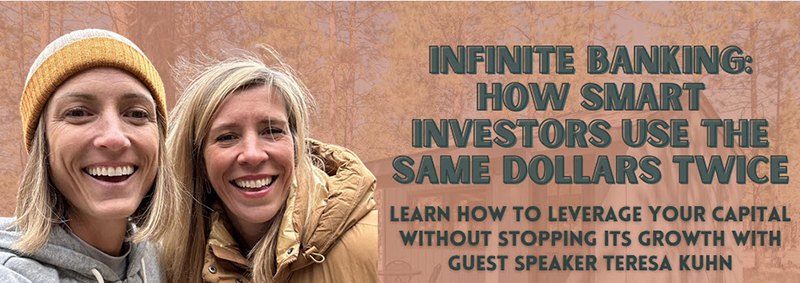
Infinite Banking: How Smart Investors Use the Same Dollars Twice
January 30, 2026